Use Your Oxgoad

0

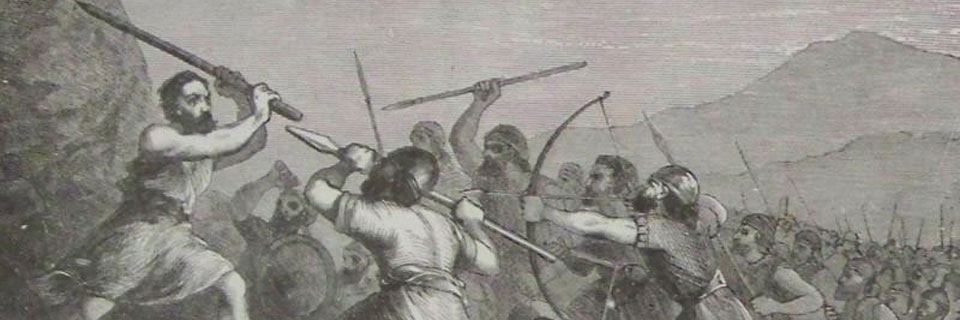
After Ehud, Shamgar son of Anath became judge. He delivered Israel by striking down 600 Philistines with an oxgoad. -Judges 3:31 (HCSB)

The book of Judges tells of the repetitive cycle the Israelites found themselves in during a course of their history. Essentially, the people would get involved with sinful activity and turn their back toward God, which in turn brought suffering upon the people. God would respond by sending a deliverer, or judge, to rescue them.

One such judge is Shamgar. We are introduced to him in Chapter 3, Verse 31, and told that he is the son of Anath; that he saved Israel; and that he killed 600 Philistines with an oxgoad.

And that’s it. The guy doesn’t even get a second verse. Shamgar is a one-verse wonder.

While one could argue that we aren’t told enough about Shamgar to warrant even studying him, perhaps what we do know from this single verse is more than sufficient.

For example, his name. Shamgar is not a Hebrew name. That point is further verified by the “son of Anath” addition. Anath was the name of the Canaanite goddess of war. So being referred to as “son of Anath” is more of a cultural clue rather than a genealogical one. So just from his name we can conclude that God used a non-Israelite to save his people. Interesting

Secondly, the man used an oxgoad to slaughter hundreds of Philistines. An oxgoad was an 8-foot long stick with a pointed, iron tip used to prod and drive oxen. It wasn’t a weapon by design… It was a farming tool. Shamgar More >

Take This Cup

0

“Father, if You are willing, take this cup away from Me—nevertheless, not My will, but Yours, be done.” -Luke 22:42 (HCSB)

Knowing that he was about to be arrested, tried and crucified, Jesus retreats with his disciples to the Garden of Gethsemane for prayer. One can’t even begin to fathom how intense and excruciating this moment had to be. Therefore, to no surprise, Jesus’ prayer begins with a plea: Father, if You are willing, take this cup away from Me—nevertheless, not My will, but Yours, be done.

As God in the flesh, Jesus knew what had to be done. But as a human, he felt the weight of the consequences as well.

Ultimately there was no choice. Jesus had to face the cup.

So what exactly is this “cup” that Jesus wants removed? Pain? Suffering? Death? As horrible as those things are, Jesus was facing something much worse.

Going back to the Old Testament, a cup is often used to symbolize God’s wrath and judgment. Those who have sinned against God are told that they must drink from this cup and endure it’s contents. It is essentially a cup filled to the brim with the horror and desolation that comes from being alienated from God the Father.

And Jesus wasn’t facing a single person’s cup… It was the wrath of God due to all humanity for their sinfulness and rebellion. The mere thought of that cup is what made Jesus plead with his Father for it to be taken away. Whips, thorns and nails couldn’t compare.

No wonder his sweat became like blood.

So how do we wrap our minds around a More >

What You Seek You Will Find

0

Finally, brothers, whatever is true, whatever is honorable, whatever is just, whatever is pure, whatever is lovely, whatever is commendable, if there is any excellence, if there is anything worthy of praise, think about these things. -Philippians 4:8 (ESV)

Do you consider yourself a negative person? One who habitually leans toward the “glass half empty” side of things? If so, I have another question… What are you looking for? Let me give you an example scenario…

Are you always nasty and argumentative with your spouse? If you are looking for reasons to be angry toward your husband or wife, you will find them. Annoying habits and traits will rise to the surface. You will jump at any opportunity to be critical of a mistake or error. You will dissect every word they say, giving you justification for your hostility. When it comes down to it, what they do will never be good enough.

The reasoning is simple: what you seek you will find.

In other words, if you want reasons to be pessimistic throughout your life, you won’t have to look very far. And the converse is true. If you want reasons to be optimistic, they will turn up everywhere as well.

And what we input into our minds, whether positive or negative, has a direct influence on our words and actions. Our thoughts do matter.

That’s why Paul’s instructions here to the church of Philippi are of utmost importance. He gives a list of 7 qualities and charges the reader to “think about these things.” Paul’s suggestion is not to search More >

What Goes Up Must Come Down

0

Like a madman who throws flaming darts and deadly arrows, so is the man who deceives his neighbor and says, “I was only joking!” -Proverbs 26:18-19 (HCSB)

Ever played a joke or prank, only have to have it completely backfire on you? You know the situation… You’re picking around with someone and then find out later that they thought there was some truth behind your words. And what is our natural first response? We get defensive and say, “C’mon, man… Can’t you take a joke?”

In Proverbs 26:18-19, Solomon describes that exact predicament — someone who deceives others, and then in turns tries to justify it by simply pointing out that it was intended as a joke.

Interestingly however, he doesn’t just say it’s wrong. Solomon takes it one step further by comparing that type of person to a madman running around wildly throwing darts and shooting arrows into the sky. One can’t deny the obvious danger presented in that situation. Sure, there’s no harm initially, but what goes up must come down. Eventually gravity will take over, the darts/arrows will return to Earth, and they will penetrate deep inside something.

In other words, if you think playing the “joke” card is a legitimate defense for trickery, lies and deception, then you are off your rocker.

Our words hold a lot of power, and Solomon here is reminding us to be careful with them — if used irresponsibly, they can be a weapon that pierce the heart as easily as arrows pierce skin.

In the end, “I was only joking” is nothing more More >

Drop Your Blanket

0

And there were in the same country shepherds abiding in the field, keeping watch over their flock by night. And, lo, the angel of the Lord came upon them, and the glory of the Lord shone round about them: and they were sore afraid. And the angel said unto them, Fear not: for, behold, I bring you good tidings of great joy, which shall be to all people. For unto you is born this day in the city of David a Saviour, which is Christ the Lord. And this shall be a sign unto you; Ye shall find the babe wrapped in swaddling clothes, lying in a manger. And suddenly there was with the angel a multitude of the heavenly host praising God, and saying, Glory to God in the highest, and on earth peace, good will toward men. -Luke 2:8-14 (KJV)

Over the past 45+ years, A Charlie Brown Christmas has been a television staple during the Christmas season. The story revolves around the title character’s frustration with the commercialization of Christmas. At his wit’s end, Charlie Brown finally exclaims, “Isn’t there anyone who knows what Christmas is all about?!”

To our surprise, Linus, the timid friend known for sucking his thumb and carrying a security blanket, speaks up. In an odd climax to a network television special, the boy then proceeds to calmly and confidently recite the Gospel of Luke, chapter 2 verses 8-14. ”That’s what Christmas is all about, Charlie Brown,” Linus concludes.

But something subtle yet very out-of-the-ordinary happens while he is speaking. Precisely at the moment when More >

Go to Top